
Free shipping on orders over $60. Shop wellness kits
Fitness & movement

Daily steps: what the research says, and where to walk in South Florida

Where the 10,000-step goal came from, what a 15-study analysis found about daily steps by age, how brisk "brisk" is in steps per minute, and eight South Florida routes from Miami Beach to the Everglades.

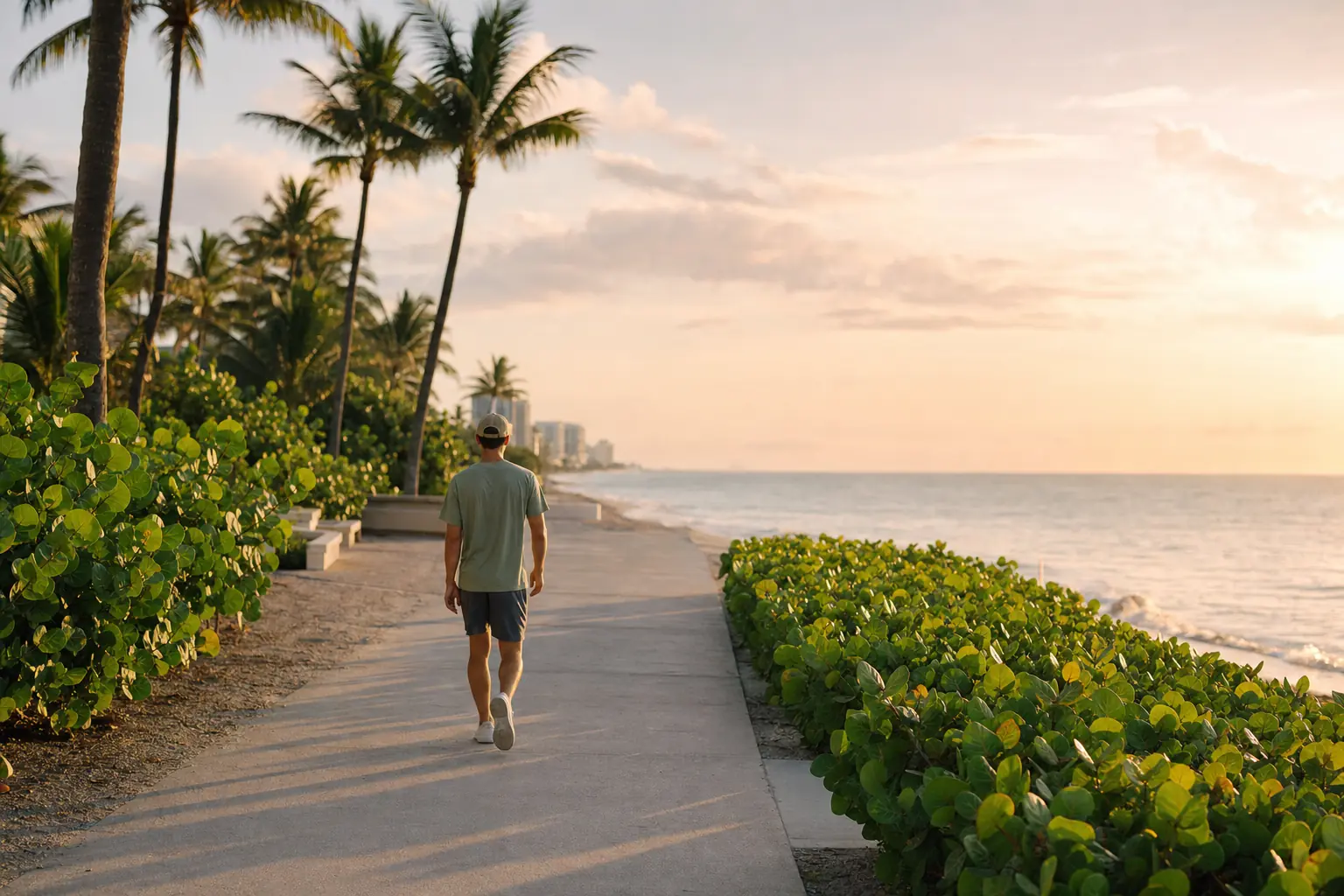
A person walking away along a palm-lined beachfront path beside the ocean at sunrise6,000–10,000Daily steps where the research association leveled off, depending on age (Paluch et al., 2022)
In this article

Key takeaways

  • The 10,000-step goal began as a marketing campaign in Japan, not as a research finding.
  • In a 2022 analysis of 15 studies and 47,471 adults, more daily steps were associated with progressively lower risk up to about 6,000–8,000 steps for adults 60 and older and 8,000–10,000 for younger adults.
  • A cadence of about 100 steps a minute marks moderate intensity for adults; about 130 marks vigorous intensity for adults aged 21–40.
  • From November through April, South Florida's mild weather makes it an easy season to add steps: the Miami Beach Beachwalk alone runs nine miles.

Where 10,000 steps came from

Ten thousand steps a day is printed on fitness trackers everywhere, but it originates from a marketing campaign in Japan, as the authors of a 2022 review in The Lancet Public Health point out. It's a round number that stuck, not a threshold that research identified. So what does the research say?

studies pooled: 7 published and 8 unpublishedPaluch et al., 2022
15
adults whose steps were measured with a device
47,471
median follow-up
7.1 years

What the research says about steps by age

Researchers pooled step-counter data from 15 studies and followed participants for a median of 7.1 years. They split people into four equal groups by daily steps. Taking more steps a day was associated with a progressively lower risk of death from any cause, up to a level that varied by age.

Median daily steps in each quarter of participantsParticipants split into four equal groups, least to most active
  • Least active quarter: 3,553
  • Second quarter: 5,801
  • Third quarter: 7,842
  • Most active quarter: 10,901
  • Most active quarter
  • The popular 10,000-step goal
View as table
Median daily steps in each quarter of participants
GroupMedian steps per day
Least active quarter3,553
Second quarter5,801
Third quarter7,842
Most active quarter10,901

Source: Paluch AE, et al. The Lancet Public Health, 2022

Where the association leveled off, by ageDaily steps beyond which risk didn't keep falling
  • Adults 60 and older6,000–8,000 steps
  • Adults under 608,000–10,000 steps
View as table
Where the association leveled off, by age
Age groupDaily steps
Adults 60 and older6,000–8,000 steps
Adults under 608,000–10,000 steps

Source: Paluch AE, et al. The Lancet Public Health, 2022

Reading this kind of study
These are associations from observational studies: they show that people who walked more tended to fare better, not that the steps alone caused it. They're useful for setting a realistic goal, alongside the national activity guidelines.

Where do most people start? Estimates depend on the device. In national accelerometer data from 2005–2006, U.S. adults averaged about 6,500 steps a day by the counting method the authors considered most realistic; a 2017 study of smartphone data put the U.S. average at 4,774.

How brisk is brisk?

The pace of your steps, or cadence, is a simple way to judge intensity without a heart-rate monitor. Count your steps for 15 seconds and multiply by four.

Walking cadence and intensity
Steps per minuteAdults 21–40Adults 61–85
About 100Moderate intensity (3 METs)Moderate intensity (3 METs)
About 110About 4 METs
About 120About 5 METs
About 130Vigorous intensity (6 METs)Not established for this age group
A MET is a multiple of the energy you use at rest. The national guidelines call 3.0–5.9 METs moderate and 6 or more vigorous.Source: Tudor-Locke C, et al., British Journal of Sports Medicine 2018; International Journal of Behavioral Nutrition and Physical Activity 2019 and 2021

Eight places to walk in South Florida

From Miami-Dade to Palm Beach County there's no shortage of flat, scenic routes. Here are eight, with lengths from the cities, parks and agencies that run them.

Route lengthsMiles, as published by the managing agency
  • Shark Valley loopEverglades National Park15 mi
  • BeachwalkMiami Beach9 mi
  • Lake TrailTown of Palm Beachnearly 6 mi
  • BroadwalkHollywoodnearly 2.5 mi
  • RiverwalkFort Lauderdale2.5 mi
  • Crandon Park beachKey Biscayne2 mi
  • Gumbo Limbo boardwalkBoca Raton¼ mi
View as table
Route lengths
RouteMiles
Shark Valley loop (Everglades National Park)15 mi
Beachwalk (Miami Beach)9 mi
Lake Trail (Town of Palm Beach)nearly 6 mi
Broadwalk (Hollywood)nearly 2.5 mi
Riverwalk (Fort Lauderdale)2.5 mi
Crandon Park beach (Key Biscayne)2 mi
Gumbo Limbo boardwalk (Boca Raton)¼ mi

Source: City of Miami Beach; Town of Palm Beach; City of Hollywood; Riverwalk Fort Lauderdale; Miami-Dade Parks; City of Boca Raton; National Park Service

Miami Beach Beachwalk

A nine-mile oceanfront promenade from South Pointe Park to 87th Street, part of the city's Atlantic Greenway Network.

Hollywood Beach Broadwalk

A brick-paved path that stretches nearly 2.5 miles along the Atlantic, shared by walkers, joggers and cyclists.

Fort Lauderdale Riverwalk

A 2.5-mile linear walk along both banks of the New River, starting at Cooley's Landing Park.

Lake Trail, Palm Beach

Nearly six miles along the Lake Worth Lagoon, from the Royal Park Bridge to the island's north end. No e-bikes or motorized vehicles.

Crandon Park, Key Biscayne

A two-mile beach plus self-guided nature trails, including a mangrove boardwalk to the fossilized reef overlook.

Gumbo Limbo, Boca Raton

A quarter-mile elevated boardwalk through a hardwood hammock to Red Reef Park West, with a 40-foot observation tower reached by ramp.

Shark Valley, Everglades

A 15-mile paved loop with an observation tower halfway, plus the short, accessible Bobcat Boardwalk (0.2 mile).

Best season

November through April brings the mildest weather. In summer, walk early and choose shade.

From miles to steps (illustrative)
DistanceApproximate steps
1 mileAbout 2,100
2.5 miles (Hollywood Broadwalk, one way)About 5,300
5 miles (the Broadwalk there and back)About 10,600
Illustrative, assuming a 2.5-foot stride (5,280 feet ÷ 2.5 = 2,112 steps per mile). Your stride, and so your count, will differ.

Adding steps, one week at a time

  • Check your current daily average for a week before picking a goal.
  • Add steps gradually, such as one short extra walk a day, and hold the new level for a week before adding more.
  • Include a few minutes at about 100 steps a minute to make part of your walk moderate intensity.
  • Walk with someone: a standing weekend walk on the Broadwalk or Riverwalk is easier to keep.
  • In the warmer months, go early, carry water and pick a shaded route.

Starting something new
If you have a heart condition, joint problems or another medical condition, or you haven't been active for a while, check with your healthcare provider before increasing your activity.

Sources

  1. Daily steps and all-cause mortality: a meta-analysis of 15 international cohorts. Paluch AE, et al. The Lancet Public Health 7(3):e219–e2282022
  2. Walking cadence (steps/min) and intensity in 21–40 year olds: CADENCE-adults. Tudor-Locke C, et al. International Journal of Behavioral Nutrition and Physical Activity 16:82019
  3. Walking cadence and intensity in 61–85-year-old adults: the CADENCE-Adults study. International Journal of Behavioral Nutrition and Physical Activity 18:1292021
  4. How fast is fast enough? Walking cadence as a practical estimate of intensity in adults. Tudor-Locke C, et al. British Journal of Sports Medicine 52(12):776–7882018
  5. Accelerometer-determined steps per day in US adults. Tudor-Locke C, Johnson WD, Katzmarzyk PT. Medicine & Science in Sports & Exercise 41(7):1384–13912009
  6. Large-scale physical activity data reveal worldwide activity inequality. Althoff T, et al. Nature 547:336–3392017
  7. Physical Activity Guidelines for Americans, 2nd editionU.S. Department of Health and Human Services, 2018
  8. BeachwalkCity of Miami Beach
  9. Hollywood BeachCity of Hollywood
  10. Riverwalk district parksRiverwalk Fort Lauderdale
  11. New resident and visitor resources (Lake Trail)Town of Palm Beach
  12. Crandon ParkMiami-Dade County Parks
  13. Boardwalk trail and observation towerCity of Boca Raton
  14. Shark ValleyNational Park Service, Everglades National Park

Information on this site is educational and is not a substitute for advice from your healthcare provider. Consult your healthcare provider before use if pregnant, nursing, taking medication or managing a medical condition. Images in this article are AI-generated illustrations.

Wellness Journal

Keep reading

Dried botanical leaves in a glass dish beside a brass loupe and lab glassware
Quality & testing6 min read

What “lab tested” really means

Heavy metals, identity, microbes and pesticides: what each test measures, how limits are set, and how to read a certificate of analysis.

A child's bedroom at dusk with a glowing lamp, picture books and a knitted rabbit on a mint bedspread
Family wellness4 min read

Building a calm bedtime routine

How much sleep children need at each age, what research says about consistent routines, and a simple wind-down you can adapt for your family.

Clusters of ripe elderberries and elderflowers beside a small amber bottle on linen
Botanicals4 min read

Elderberry, from hedgerow to syrup

Which elder is which, when the flowers and berries are ready, and why the berries are always cooked before they become a syrup.